According to Great Retirement Communities, Pecan Plantation's monthly dues run $200 to $525, depending on whether you're in a condo or a single-family home. According to Mallard Pointe's FAQ, its annual assessment is $418 per lot. Divide that out and you're looking at roughly $35 a month, less than a fifth of what Pecan Plantation's floor charges every thirty days.
On paper, Mallard Pointe looks like the deal. In practice, that comparison tells you almost nothing, because the two numbers aren't measuring the same thing. One is a bundled monthly fee that folds in a clubhouse, pools, tennis courts, a marina, an activity center, and access to a shopping village with a grocery store, a bank, and a pharmacy. The other is a bare per-lot assessment that doesn't include a golf course, a clubhouse, or anything beyond a shared marina and its two named parks, Pintail and Wigeon. Compare the sticker and you'll draw the wrong conclusion. Compare what's actually inside the number and a different picture shows up, one that matters a lot more if you're deciding between Lake Granbury communities based on more than a headline dues figure.
One-Time and Ongoing Costs to Compare
Pecan Plantation is the clearest example of dues that look larger than they are, once you know what they cover. That $200 to $525 monthly range gives residents access to nearly everything on the property except the golf course, which carries its own separate initiation fee and monthly charge, with additional paid tiers available through the Nutcracker Golf and Fitness Club for residents who want more than the standard membership. On top of the recurring dues, buyers typically owe a one-time capital contribution of about $5,500 at closing, plus a documented HOA transfer fee of $1,153.97 on the association's TREC-filed management certificate. Neither of those shows up in a listing's price per square foot. Both show up on the closing statement.
That's the part buyers miss when they're comparing communities off a spreadsheet of monthly dues alone. A $325 monthly fee sounds steep next to a $35 one until you realize the $325 already includes the pool, the tennis courts, the marina, the activity center's dog park and indoor basketball court, and the 17 miles of Brazos River frontage that wraps the property's three riverside parks. The $35 fee doesn't include Pecan Plantation's pool, tennis courts, activity center, or 17 miles of Brazos River frontage, because Mallard Pointe isn't trying to fund a golf course, a clubhouse, or a private airstrip. It's funding a marina and two parks, and that's about it.
A Neighborhood Where the Math Runs the Other Way
Mallard Pointe publishes its numbers plainly. The current annual assessment, per the association's own FAQ, is $418 per lot and $251 per boat slip, due every January 1. That's it. No capital contribution, no transfer fee mentioned in the public documents, no golf membership to negotiate.
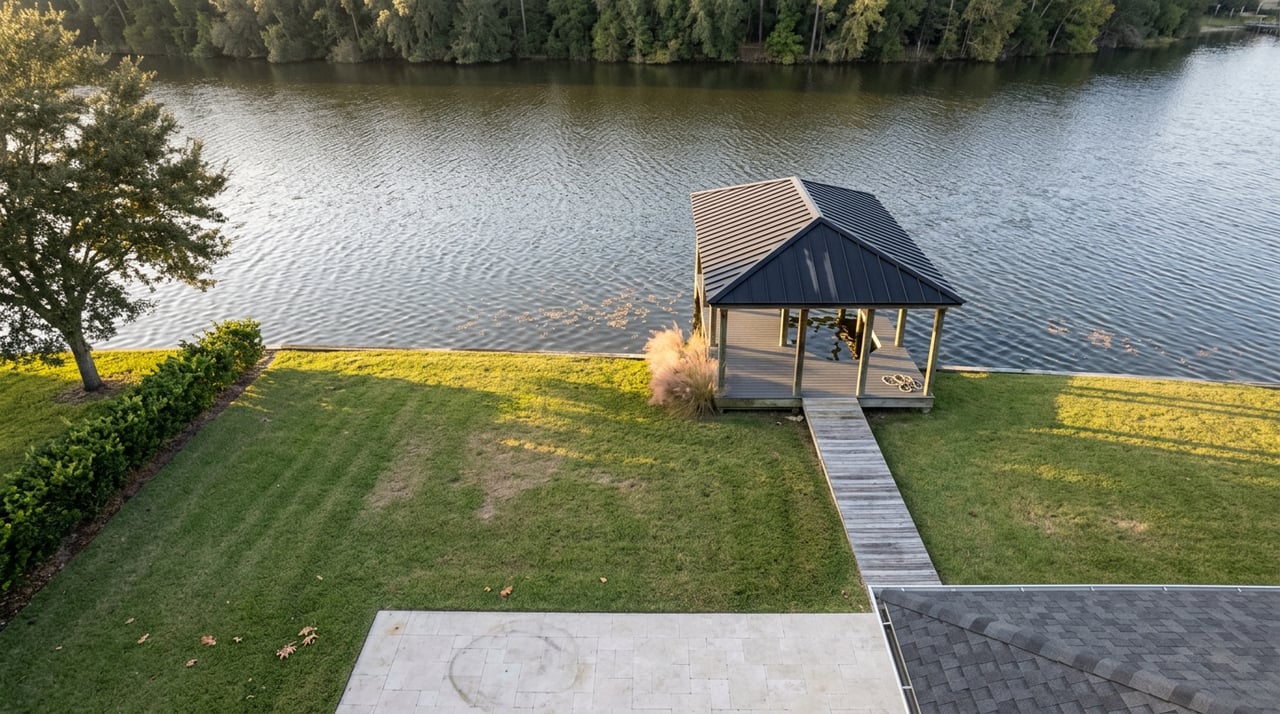
What that low number buys is narrower than what Pecan Plantation's buys. Mallard Pointe has 176 building lots and five acres of parks, including Pintail Park and Wigeon Park, built around a peninsula that juts into the lake, with a community marina where slip owners can lease their spot only to another Mallard Pointe property owner under the association's covenants. There's a shared dumpster for brush and DIY project debris, but it's explicitly not for household trash. Residents still need to arrange their own trash service separately, since Mallard Pointe isn't gated and its roads belong to Hood County rather than the association. That last detail matters more than it sounds like it should. A community with lake access and a private marina, sitting on ungated county roads, is a different ownership experience than a gated, staffed property like Pecan Plantation or DeCordova Bend Estates, even if all three sit on the same lake.
How DeCordova Bend Estates Structures Its Costs
Rather than setting out a flat dues figure, DeCordova Bend Estates ties ownership to a fractional interest in the whole club. According to DeCordova Bend Estates' membership types page, each property carries roughly a 1 in 1,500 share of the association, with one vote per property in club elections. That structure means your actual cost depends on the total membership and the club's operating budget in a given year, not a flat number you can look up before calling anyone. The association's own site doesn't post current dues. It tells prospective buyers to go through a realtor to arrange a visit.
What you do get, once you're in, is a genuinely well-built golf course, designed by Leon Howard and Dave Bennett, ASGCA, with greens converted to Champions Bermuda in a 2016 renovation. The club also hosts the Acton/DCBE Volunteer Fire Department Tournament every June, a charity event that's one of the only times the course opens to non-residents. It's a small detail, but it says something about the community: gated, golf-focused, and close enough to its surrounding fire department that the club calendar includes a fundraiser for it. About 4,000 residents call it home, roughly 45 minutes from downtown Fort Worth.
Some Costs Aren't Dollars. They're a Line You Wait In.
Not every cost in a Lake Granbury HOA shows up as a number at all. In Sky Harbour, buyers have run into marina slip waitlists stretching close to two years, meaning a household can close on a lakeside home and still not have a place to tie up a boat for a long stretch afterward. Building a new dock in several of these communities isn't a single approval either.
If marina access is the whole point of buying on the water, Indian Harbor is worth a look precisely because it sidesteps some of that friction. Sitting about four miles southeast of Granbury, it's a gated community with its own marina and boat ramp, generally positioned as a more accessible entry point to lake access than the higher-amenity communities further out.
What a Slower Market May Mean for Buyers
Granbury's price data depends heavily on which tracker you're reading, and the honest answer is that the sources don't agree with each other right now. As of August 2026, one tracker puts Granbury's median list price at $395,000, down 5 percent from a year earlier, with homes sitting a median of 97 days before going under contract. A separate index, using Zillow's home value methodology and updated through the middle of this year, shows an average value of $368,168, up a modest 0.4 percent year over year, with homes going pending in about 22 days, a much faster pace than the list-price tracker suggests. A third source, pulling Redfin's underlying data for May 2026, shows a median sale price of $385,000, up 16.7 percent year over year, with 5.0 months of supply and just over a third of active listings showing a price cut.
Three different numbers, three different directions. What they agree on is texture, not headline. Inventory is up compared to a year ago in some readings, price cuts are showing up on more than a third of listings in at least one tracker, and days on market are longer than the tightest years of the past cycle. That combination means something practical for anyone comparing Lake Granbury HOAs right now: you have time. A market where homes sell in three weeks doesn't leave room to request a reserve study, a current dues statement, and a marina waitlist status before writing an offer. A market with 97-day medians and meaningful price reductions does.
Before You Write the Offer, Ask For
- The current dues schedule and the most recent association budget, not just the number quoted in the listing
- Whether a one-time capital contribution or transfer fee applies at closing, and the exact dollar amount
- Whether golf, tennis, or marina access is bundled into dues or billed as a separate membership
- Current wait times for marina slips or dry dock storage, if lake access matters to you
- Whether architectural review is handled by a fast-moving committee or a formal board that meets monthly
- Any restrictions on livestock, short-term rentals, or fencing that would affect how you actually want to live there
FAQ
Are all the lake communities around Granbury gated? No. Mallard Pointe, for example, is explicitly not gated, since its roads belong to Hood County rather than the association, even though it maintains a private marina and slip system for its members. Gating and amenity access aren't the same thing, and it's worth checking both separately.
How do I find out if a community has a marina waitlist before I make an offer? It's not something you'll find in an MLS listing. The only reliable way is to ask the HOA or club directly, since wait times can run into years in some higher-demand communities and are worth knowing before you get attached to a specific address.
If you're weighing Pecan Plantation against Mallard Pointe, or trying to figure out whether DeCordova Bend's golf membership structure makes sense for your family, that's exactly the kind of comparison worth walking through before you write an offer, not after. Ryan Barnes works these Lake Granbury communities directly and can pull the actual dues schedule, transfer fee, and current waitlist status for any HOA you're considering. Let's Connect.
This article is general information, not legal, tax or financial advice. Consult a qualified professional about your situation.